Searching Community Memory Posts in 1987
Community Memory was a digital bulletin board “for the unmediated sharing of information for use by the general public” (Farrington 1987) deployed in three generations around Berkeley, California from 1974 to 1991. With terminals placed in public places, members of the public could read and write messages to each other, entertain themselves, find information, and conduct business. In 1987, a staff member at the Community Memory Project created a report on users' search patterns, which survived to be archived at the Computer History Museum. This dataset is a rare glimpse into how a non-computer enthusiast, pre-Internet general population used a proto-social network. By analyzing the dataset using NLP techniques, we find the top three search clusters, each about a fifth of the total, are 1) buying and selling products (“for sale”), 2) debate and general discussion, and 3) searching for posts by prominent personalities. Unexpectedly, erotic-related queries are the fourth most popular with 9% of the total.
Background
The Community Memory Project aimed to provide a digital, two-way public bulletin board system where users would post messages and reply to each other, without a censor. Although the Project seeded the system with some initial messages to help users understand it, what users wrote and how users organized and consumed messages, was left open. The Project did not want to limit access to members of the public who owned a computer, nor advantage members who did, so access to the system was only via terminals placed in public locations such as grocery stores, community centers, and libraries. Users did not need accounts and could post anonymously. Although the Project considered some approaches for monetization, none were ever implemented, so access was free.
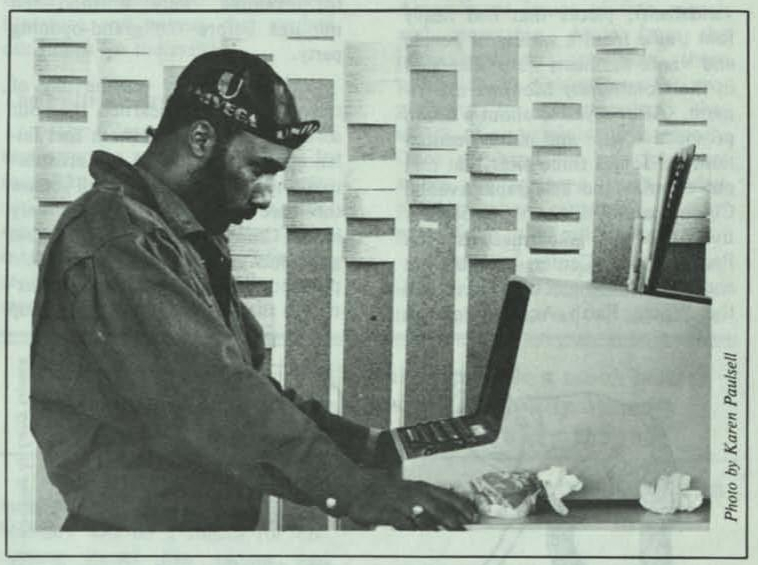
When a user posted a message, they could add index terms, effectively labels, to the message to help others find it. The list of index terms was open, although the system had some recommendations. The Project’s engineering team iterated through a number of designs, attempting to find the right trade-off between power and ease-of-use. Searching for messages involved either picking index terms from lists or typing them in directly.
Since the system was so flexible, it was challenging to understand how the community was using it and how that should shape the future development of the system. In 1987, the Project created a report of the frequency of index terms used in searches. Interpreting the data is difficult, from reasons including natural ambiguity of terms and the fact that the list contains many typos, singular and plural forms, and much noise. In this article, we use some modern natural language processing techniques to gain insight into what community members were searching for.
Methodology and Data Quality
The Computer History Museum’s scan of the report is held under 102734454-05-0001-acc. We used Google’s Gemini 3.7 Flash (see appendix for the prompt) to convert the PDF into a text document (OCR output). We chose Gemini 3.7 because it had the best OCR performance in our tests. Since each row in the table contains sets of columns that sum to the total (picked and typed, and the four sites), we were able to verify the imputed dataset was consistent under these rules. We also visually checked the first hundred entries (of 1,266) and, in the case of some ambiguous text entries, compared them to the second copy of the report in the artifact.
The report includes this explanatory preface:
The attached table lists the index words used in searches, in order of frequency (and in alphabetic order within a frequency). The last four of the seven columns are the 4 terminal sites. The first column is the total for all 4 sites. The column headed “Pick” indicates how many times those words were picked from an index list; the column headed “Type” shows how many times the words were typed. Note that words may be picked from a list of related index words rather than the main index word menu; no attempt was made to determine this.
Typed phrases and gibberish are truncated at 38 characters
The time period represented is September 18 - December 10, 1987.
The original report includes a table summarizing counts by columns. If we compare these numbers to the ones in our output, we discover an under count discrepancy of five (5). This represents less than 0.1% of the total number of searches, and since individual rows were consistent, we believe this transcription is of high quality.
| Searches | OCR Sum | |
|---|---|---|
| All sites | 5780 | 5775 |
| Picked | 2826 | 2822 |
| Typed | 2954 | 2953 |
| Pena | 1182 | 1179 |
| Coop | 1364 | 1362 |
| WEA | 966 | 966 |
| Shattuck | 2268 | 2268 |
What did community members search for?
The top 75 raw search terms, with their frequency, how often they were picked from a software provided list versus typed directly by the user, and how often they were searched by one of the four terminal sites, are displayed in the table below.
Table: Search Words or Terms by Frequency, Creation Method, and Location
| Word(s) | Tot | Pick | Type | pena | coop | wea | shat |
|---|---|---|---|---|---|---|---|
| adam | 379 | 303 | 76 | 98 | 119 | 60 | 102 |
| sex | 316 | 233 | 83 | 63 | 79 | 56 | 118 |
| love | 205 | 131 | 74 | 55 | 27 | 38 | 85 |
| jokes | 147 | 88 | 59 | 39 | 38 | 35 | 35 |
| housing | 138 | 86 | 52 | 20 | 17 | 6 | 95 |
| car | 134 | 92 | 42 | 16 | 26 | 33 | 59 |
| eku | 133 | 65 | 68 | 5 | 23 | 3 | 102 |
| art | 117 | 67 | 50 | 30 | 30 | 29 | 28 |
| computer | 114 | 86 | 28 | 13 | 36 | 33 | 32 |
| gay | 96 | 50 | 46 | 17 | 20 | 20 | 39 |
| fantasy | 90 | 55 | 35 | 28 | 14 | 17 | 31 |
| joke | 88 | 55 | 33 | 21 | 21 | 29 | 17 |
| apartment | 83 | 52 | 31 | 26 | 21 | 5 | 31 |
| dead | 83 | 60 | 23 | 12 | 29 | 22 | 20 |
| berkeley | 81 | 57 | 24 | 14 | 17 | 23 | 27 |
| music | 78 | 38 | 40 | 24 | 13 | 13 | 28 |
| drugs | 77 | 45 | 32 | 25 | 14 | 15 | 23 |
| auto | 76 | 49 | 27 | 10 | 14 | 21 | 31 |
| jobs | 64 | 35 | 29 | 11 | 16 | 15 | 22 |
| drummer | 61 | 48 | 13 | 10 | 8 | 6 | 37 |
| house | 59 | 42 | 17 | 10 | 10 | 3 | 36 |
| work | 55 | 47 | 8 | 13 | 9 | 7 | 26 |
| women | 53 | 39 | 14 | 8 | 18 | 9 | 18 |
| dance | 51 | 30 | 21 | 14 | 13 | 13 | 11 |
| cars | 46 | 31 | 15 | 7 | 6 | 12 | 21 |
| computers | 45 | 30 | 15 | 5 | 9 | 19 | 12 |
| death | 45 | 26 | 19 | 17 | 6 | 9 | 13 |
| gnauvel | 44 | 0 | 44 | 13 | 4 | 0 | 27 |
| free | 42 | 23 | 19 | 4 | 7 | 12 | 19 |
| fun | 41 | 19 | 22 | 10 | 7 | 13 | 11 |
| pan | 39 | 0 | 39 | 3 | 6 | 0 | 30 |
| karen | 37 | 18 | 19 | 7 | 8 | 13 | 9 |
| america | 36 | 20 | 16 | 15 | 4 | 9 | 8 |
| share | 36 | 29 | 7 | 5 | 5 | 0 | 26 |
| witch | 36 | 26 | 10 | 10 | 8 | 4 | 14 |
| kaos | 31 | 19 | 12 | 9 | 6 | 7 | 9 |
| rent | 30 | 23 | 7 | 3 | 6 | 2 | 19 |
| iran | 29 | 17 | 12 | 10 | 2 | 9 | 8 |
| sale | 28 | 23 | 5 | 2 | 5 | 6 | 15 |
| wanted | 28 | 22 | 6 | 7 | 9 | 3 | 9 |
| g | 27 | 21 | 6 | 9 | 3 | 6 | 9 |
| rental | 27 | 22 | 5 | 3 | 9 | 0 | 15 |
| room | 26 | 23 | 3 | 1 | 6 | 1 | 18 |
| ansku | 24 | 21 | 3 | 4 | 4 | 3 | 13 |
| food | 24 | 11 | 13 | 8 | 2 | 9 | 5 |
| people | 24 | 15 | 9 | 12 | 4 | 3 | 5 |
| help | 22 | 17 | 5 | 8 | 4 | 0 | 10 |
| message | 22 | 21 | 1 | 7 | 5 | 3 | 7 |
| farming | 21 | 9 | 12 | 2 | 6 | 4 | 9 |
| information | 21 | 17 | 4 | 5 | 3 | 5 | 8 |
| cm | 20 | 13 | 7 | 5 | 6 | 4 | 5 |
| doctor | 20 | 10 | 10 | 5 | 7 | 3 | 5 |
| reagan | 20 | 16 | 4 | 8 | 6 | 4 | 2 |
| call | 19 | 17 | 2 | 2 | 3 | 5 | 9 |
| community | 19 | 10 | 9 | 6 | 6 | 3 | 4 |
| politics | 19 | 12 | 7 | 6 | 5 | 4 | 4 |
| stern | 18 | 12 | 6 | 4 | 9 | 3 | 2 |
| fuck | 17 | 13 | 4 | 5 | 3 | 1 | 8 |
| lee | 17 | 7 | 10 | 2 | 5 | 4 | 6 |
| life | 15 | 8 | 7 | 4 | 4 | 4 | 3 |
| pagan | 15 | 12 | 3 | 2 | 6 | 2 | 5 |
| political | 15 | 10 | 5 | 6 | 1 | 4 | 4 |
| california | 14 | 10 | 4 | 3 | 2 | 2 | 7 |
| index | 14 | 7 | 7 | 2 | 7 | 1 | 4 |
| lesbian | 14 | 3 | 11 | 3 | 3 | 1 | 7 |
| rodney | 13 | 1 | 12 | 1 | 1 | 0 | 11 |
| adam stern people | 12 | 0 | 12 | 0 | 12 | 0 | 0 |
| leader | 12 | 2 | 10 | 0 | 10 | 0 | 2 |
| yes | 12 | 0 | 12 | 2 | 6 | 2 | 2 |
| apple | 11 | 7 | 4 | 0 | 4 | 3 | 4 |
| carl | 11 | 0 | 11 | 4 | 1 | 0 | 6 |
| radio | 11 | 8 | 3 | 2 | 4 | 2 | 3 |
| want | 11 | 9 | 2 | 4 | 0 | 3 | 4 |
| jazz | 10 | 5 | 5 | 2 | 2 | 0 | 6 |
| need | 10 | 9 | 1 | 4 | 1 | 2 | 3 |
The list has a long-tail. There are 62 terms searched three times, 131 terms searched twice, and 925 terms searched once.
The dataset does not include data about sessions or users. Thus, a weakness of our analysis is we cannot tell if a search query comes from many users or one. A single user could create a prominent search term in the list by merely searching for it once per week.
Who were Adam, EKU, Gnauvel, and Pan? Carl and Karen?
These unusual search terms were prolific users. Adam and EKU appear to have engaged in a long running feud and other users, or maybe sock puppets, commented on their posts. Similarly, Gnauvel and Pan traded barbs. Carl and Karen were members of the Community Memory staff and provided community updates.
All messages in CM were public. Messages were, by default, anonymous, but could be signed.
Were some searches particular to a site?
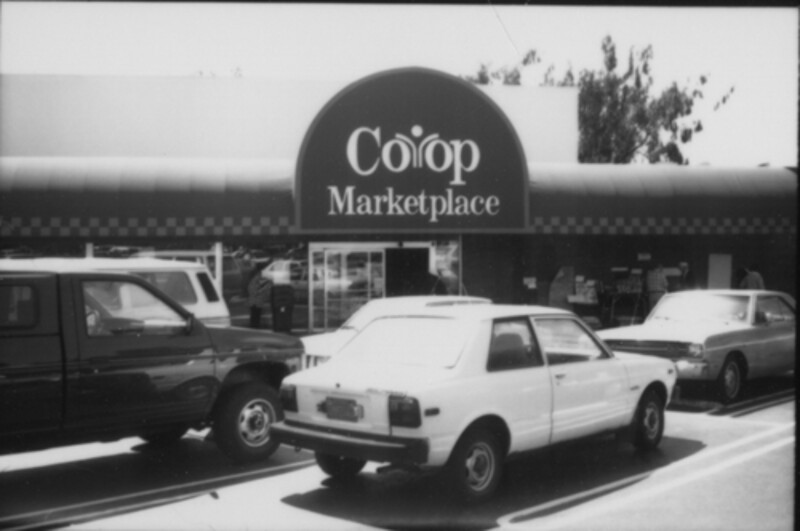
At the time of the report, CM had terminals at four locations. (One could also access CM at their headquarters, but those searches were not included.) Each site provided about six square feet for the terminal, as well as an electrical and telephone link. Of the four locations, two were stores operated by the Consumers' Cooperative of Berkeley. WEA was a Whole Earth Access store (financially unrelated to Whole Earth Catalog) and Pena refers to the La Peña Cultural Center. In contrast to the first generation of Community Memory, none of the sites were student-dominated. (In the map below, the tan rectangular area to the west of Panoramic Hill is UC Berkeley.)
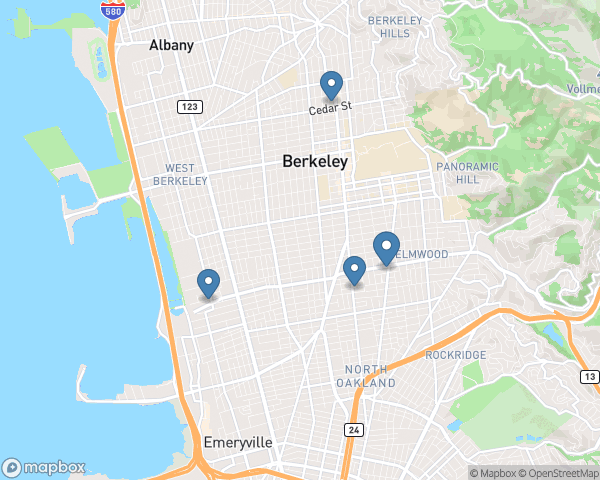
If we filter to the first fifty items in rank, or searches with n>20 count, individual sites correlate (Pearson) highly with the total search count (table below). The Coop site, which was also the longest-running location, has a 0.95 score. Pena is similar with a 0.92. WEA and Shattuck have the lowest correlation to the total at 0.87.
Table: Correlation of the Top-50 Search Term Frequencies with Combined Total
| Location | Correlation with Tot |
|---|---|
| Pena | 0.92 |
| Coop | 0.95 |
| WEA | 0.87 |
| Shattuck | 0.87 |
Predictably, sex was universally popular as a search term across all locations. adam was also popular across all four sites, although Shattuck showed an unusually high prominence for eku. The Shattuck location may have been the “home” for EKU and the author was searching for mentions of their name. The prominence of housing for Shattuck may be due to the proximity of off-campus cooperative student housing. However, broadly, the sites are indistinct.
Table: Top Ranked Search Terms by Site
| Overall | Pena | Coop | WEA | Shattuck |
|---|---|---|---|---|
| adam | adam | adam | adam | sex |
| sex | sex | sex | sex | eku |
| love | love | jokes | love | adam |
| jokes | jokes | computer | jokes | housing |
| housing | art | art | car | love |
| car | fantasy | dead | computer | car |
| eku | apartment | love | art | gay |
| art | drugs | car | joke | drummer |
| computer | music | eku | berkeley | house |
| gay | joke | apartment | dead | jokes |
| fantasy | housing | joke | auto | computer |
| joke | gay | gay | gay | fantasy |
| apartment | death | women | computers | apartment |
| dead | car | housing | fantasy | auto |
| berkeley | america | berkeley | drugs | pan |
| music | dance | jobs | jobs | art |
| drugs | berkeley | fantasy | music | music |
| auto | computer | drugs | dance | berkeley |
| jobs | gnauvel | auto | fun | gnauvel |
| drummer | work | music | karen | share |
| house | dead | dance | cars | work |
| work | people | adam stern people | free | drugs |
| women | jobs | house | women | jobs |
| dance | drummer | leader | death | cars |
| cars | house | work | america | dead |
Cluster and Classification
We used the Gemma model (specifically, embeddinggemma-300m) to obtain a 768-dimensional embedding for each search term. Then, we iteratively built clusters around each search term using cosine similarity. After review of various thresholds, we found that the 70% threshold seemed to provide excellent recall, including many typos, plurals, and similar concepts, while maintaining satisfactory precision. Below are examples for housing and computer.
Table: Similar Terms to housing
| Cosine Similarity | Term List |
|---|---|
| >65 | a, aaa, apart, apartment, apartments, apartmeny, appartment, ar, as, auto, autos, b, berkeley, bicycle, books, boston, british, buyers, childcare, dick, drugsi, eadd, employment, emt, ex, f, fantasy, farming, fishing, flat, for sale, freedom, g, garening, gay, gay housing, hare, help, help wanted, hhoussiin, hire, ho, home, honeymooners, hoousing, hop, hous, house, house huous, houseate, housemate, houses, housewware, housin, housin g, housing, housing si, housing wanted, housing yesjho, housingd, housingg, housingshare women, indian, jfk student-to-be needs housing, jjobs, job, jobs, jy, k, kitchen, ky, l, law, life, mac, marriage, moving, nah, office, oo, p, painting, pet, pets, political, question, rent, rental, rental wanted, rentals, room, roomates wanted, rover, school, share rentals, shelter, space, sublet, tree, u, union, v fgr ov apartment, vw, warehouse, wealth, women housing, work, zen |
| >70 | apart, apartment, apartments, appartment, gay housing, home, hoousing, hous, house, house huous, houseate, housemate, houses, housewware, housin, housin g, housing, housing si, housing wanted, housing yesjho, housingd, housingg, moving, rent, rental wanted, rentals, room, roomates wanted, shelter, sublet, women housing |
| >75 | apartment, apartments, gay housing, home, hoousing, hous, house, house huous, houses, housewware, housing, housing si, housing wanted, housing yesjho, housingd, housingg, rent, women housing |
| >80 | gay housing, house, houses, housing, housing si, housing wanted, housing yesjho, housingd, housingg, women housing |
| >85 | housing, housing si, housing wanted, housingd, housingg |
Table: Similar Terms to computer
| Cosine Similarity | Term List |
|---|---|
| >65 | bicycle, cmusers, commodore, compputers, computer, computer, informatin, computers, computers., computr, cybher, dictatorship, computer, disk, guitar, hacker, help, ibm, kalu, keyboard, love.computer., mac, macintosh, memory, modem, office, omputer, printer, software, synth, typewriter, work |
| >70 | computer, computer, informatin, computers, computers., computr, dictatorship, computer, keyboard, love.computer., mac, macintosh, omputer, typewriter |
| >75 | computer, computer, informatin, computers, computers., computr, omputer |
| >80 | computer, computer, informatin, computers, computers., computr, omputer |
| >85 | computer, computers, computers., omputer |
We compare the ordering of terms in the original listing with clusters at various thresholds in the table below. In the 70% case, the adam cluster includes eku, which is appropriate given their running feud, although unexpected from a language perspective. The clustering process raises the prominence of housing and car, while lowering love and jokes, suggesting more commercial applications for Community Memory than just entertainment.
| Original Rank Order | Cosine > 70% | Cosine > 75% | Cosine > 80% |
|---|---|---|---|
| adam | adam | adam | adam |
| sex | sex | sex | sex |
| love | housing | housing | car |
| jokes | car | car | jokes |
| housing | jokes | jokes | love |
| car | love | love | housing |
| eku | computer | eku | computer |
| art | art | computer | eku |
| computer | fantasy | jobs | dead |
| gay | dead | dead | gay |
| fantasy | jobs | art | art |
| joke | berkeley | gay | fantasy |
| apartment | music | fantasy | apartment |
| dead | drugs | music | music |
| berkeley | drummer | berkeley | berkeley |
| music | women | drugs | drugs |
| drugs | kaos | witch | jobs |
| auto | dance | drummer | rent |
| jobs | gnauvel | women | drummer |
| drummer | fun | dance | work |
| house | pan | gnauvel | women |
| work | karen | free | dance |
| women | d | fun | gnauvel |
| dance | free | pan | free |
| cars | politics | share | fun |
| computers | share | fuck | pan |
| death | wanted | karen | karen |
| gnauvel | america | america | share |
| free | people | politics | witch |
| fun | fuck | rental | fuck |
| pan | sale | sale | america |
| karen | cm | motorcycle | politics |
| america | iran | cm | kaos |
| share | food | kaos | iran |
| witch | doctor | iran | sale |
| kaos | pagan | food | wanted |
| rent | rental | wanted | room |
| iran | help | ansku | food |
| sale | reagan | room | people |
| wanted | message | message | message |
| g | motorcycle | people | ansku |
| rental | information | help | help |
| room | farming | information | motorcycle |
| ansku | community | d | information |
| food | life | farming | cm |
| people | call | doctor | farming |
| help | stern | reagan | pagan |
| message | lee | community | doctor |
| farming | carl | call | reagan |
| information | goob | stern | community |
| cm | rodney | lee | call |
| doctor | peace | carl | stern |
| reagan | god | dog | lee |
| call | index | index | lesbian |
| community | apple | lesbian | life |
| politics | jazz | life | california |
| stern | yes | california | rodney |
| fuck | martial art | rodney | d |
| lee | space | apple | index |
| life | horsemen | yes | yes |
| pagan | leader | god | horsemen |
| political | omega | horsemen | s&m |
| california | radio | s&m | adam stern people |
| index | paraffinagin | adam stern people | leader |
| lesbian | software | leader | apple |
| rodney | midi | radio | carl |
| adam stern people | s&m | want | omega |
| leader | spike | omega | radio |
| yes | camera | paraffinagin | want |
| apple | tm | software | paraffinagin |
| carl | need | jazz | software |
| radio | money | need | jazz |
| want | tv | health | need |
| jazz | memory | peace | health |
| need | judy | goob | r.l. |
Using the 70% threshold cluster grouping, fifty percent of searches fall into these eleven (11) clusters:
| Cluster | Total (Original) | Total (Combined) | Percentage |
|---|---|---|---|
| adam | 379 | 570 | 9.87% |
| sex | 316 | 483 | 8.36% |
| housing | 138 | 367 | 6.35% |
| car | 134 | 308 | 5.33% |
| jokes | 147 | 250 | 4.33% |
| love | 205 | 218 | 3.77% |
| computer | 114 | 173 | 3.00% |
| art | 117 | 137 | 2.37% |
| fantasy | 90 | 137 | 2.37% |
| dead | 83 | 136 | 2.35% |
| jobs | 64 | 131 | 2.27% |
The top 75 clusters comprise about 83% of all searches (figure below, log scale):
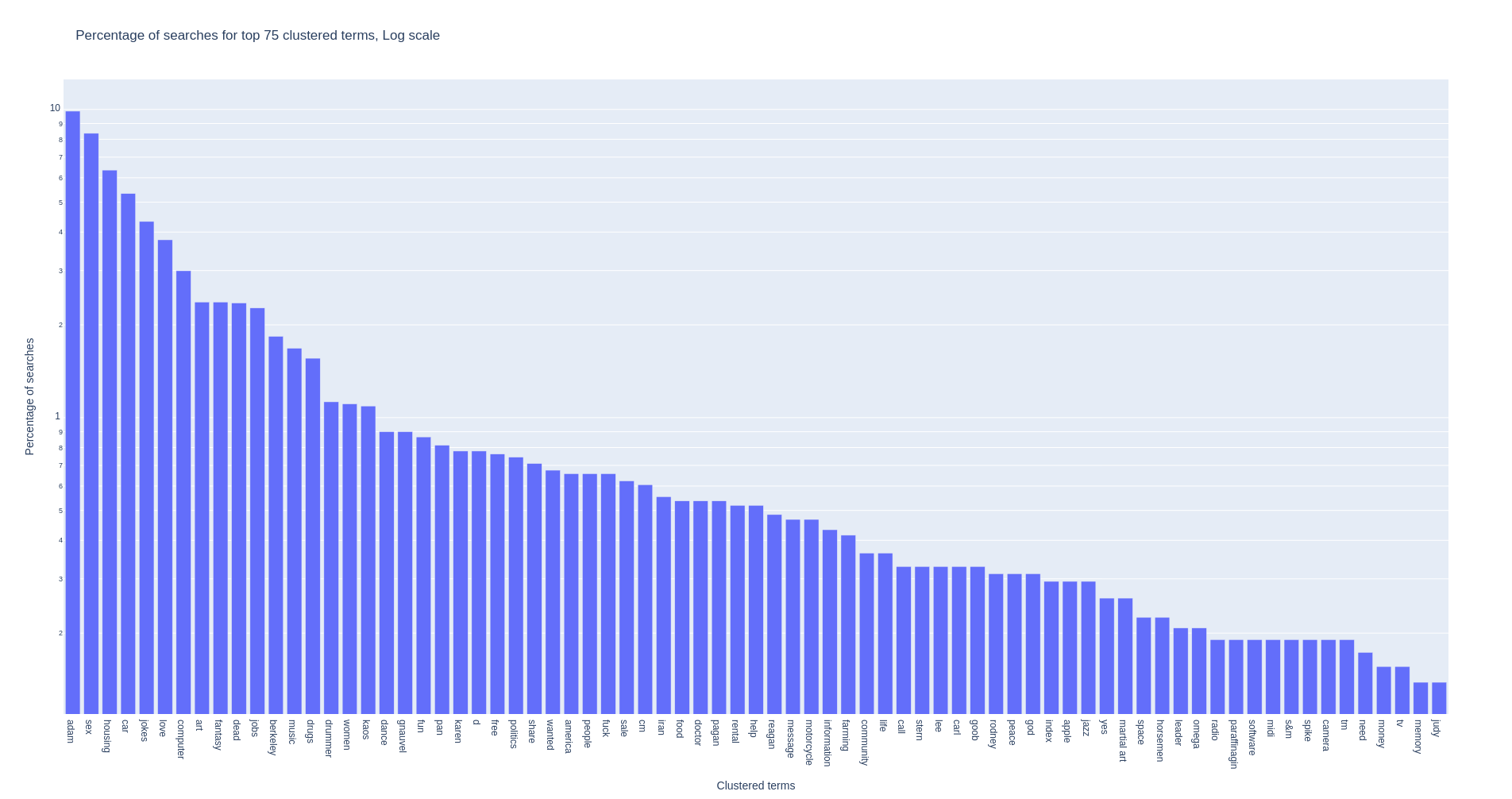
These clusters suggest that users were primarily drawn to and used Community Memory for entertainment, eroticism, commercial needs (places to live, commute, jobs and trade), and finally information, debate, and social connection. However, this ranking is based on the top ranked clusters and ignores contributions from the long tail.
Classifying Clusters into Classified Item Categories
Focusing on the prevalence of individual search queries can be deceitful as the long tail may contain many items that are common in intent or category. To further understand how the clusters relate to user intent, we classified each cluster, based on the collective terms gathered under the 70% threshold, into a set of categories. The categories are based on the top-level Craigslist list of types, which themselves were inspired by newspaper classifieds. We include “personals” and “erotic” (no longer included in Craigslist) because of their prominence in the index term list, as well as “forum” for the general debate items. Finally, we add “individuals” to capture queries for a specific user’s posts. This list and the criteria we used is displayed below.
Table: Classified Item Categories and their Criteria
| Classified Category | Criteria |
|---|---|
| community | activities, events, local news and politics, volunteer opportunities |
| erotic | sex, nudity, and other erotic content |
| for sale | antiques, appliances, computers, garage sales, furniture, tools, and other things for sale |
| forum | discussions about topics including philosophy, jokes, politics, and sports |
| gigs | jobs and employment opportunities that are short term |
| housing | apartments, rooms for rent, housing rentals, real estate sales |
| individuals | posts about specific people or usernames |
| jobs | jobs and employment opportunities that are medium to long term |
| personals | dating, meetups, and personal connections |
| services | computer, creative, financial, household, legal, and similar services |
Using the commercial model Jev (version 1.13.0), we classified each cluster using the criteria above as a first draft (see appendix). We then manually corrected the model’s output; “community” and “forum” saw the highest number of corrections. We note that these are the author’s best guess of the community member’s intent, based on our contextual knowledge of the area and reading many posts. However, there are examples like “french” (n=1): was the community member looking for someone named French, were they looking to obtain French language lessons, looking for local French expat groups, or looking for a discussion about France? We classified the query as “community,” but we do not have a true “ground truth” for any of the data.
Table: Percentage of Queries by Classified Category / Predicted Intent
| Classified Category Prediction | Percentage |
|---|---|
| for sale | 21% |
| forum | 19% |
| individuals | 18% |
| erotic | 9% |
| housing | 8% |
| community | 7% |
| personals | 7% |
| services | 5% |
| jobs | 3% |
| gigs | 2% |
The resulting group has trade in products (“for sale”) rising to the top with a fifth of all queries, followed by another fifth for “forum” or general debate. Searches for specific individuals, perhaps driven by entertainment from their posts, is a close third with 18% of the total. Unexpectedly, the erotic category is fourth with 9% of the total.
If cars were its own category, rather than part of the for sale category, for sale would drop to third place with 16% and cars and services would compete around 5%.
Contrast: Internet Search Engines
We can also compare CM’s search queries to later data from internet search engines. Searching the web, particularly in the 1990s, lacks the focus on local resources that a bulletin board would provide, so these are only loosely comparable. (Jansen 1998) is an early study of Excite.com user queries (n=51,473) made around March 9, 1997. This represents a snapshot roughly ten years after the CM report. The focus of this study is more on how users are formulating their queries than what they are searching about, but Table 8 within the article breaks down individual term frequency within search queries. This list includes many stop words and breaks apart words that together might better imply intent (e.g. “college”, “new”, “university”), but the list shows interest in erotic topics, music, software, sports, finding jobs, and a long list of entertainment or commercial interests.
(Silverstein 1999) is a close-in-time but much larger study was made using AltaVista records. This study covered approximately 843 million non-empty queries made over 43 days between August 2, 1998 and September 13, 1998. AltaVista users used shorter queries than the Excite user base and Table 4 in the article sums frequency by the entire search query, rather than by individual terms. The list (below) is dominated by erotic and entertainment related queries and lacks employment, housing, or commercial topics (beyond digital items). In addition, the list includes navigational queries (absent from the Excite list) or queries to find specific websites by their domain name or brand name. Navigational queries would later dominate search queries (e.g. Google Trends rankings for 2007).
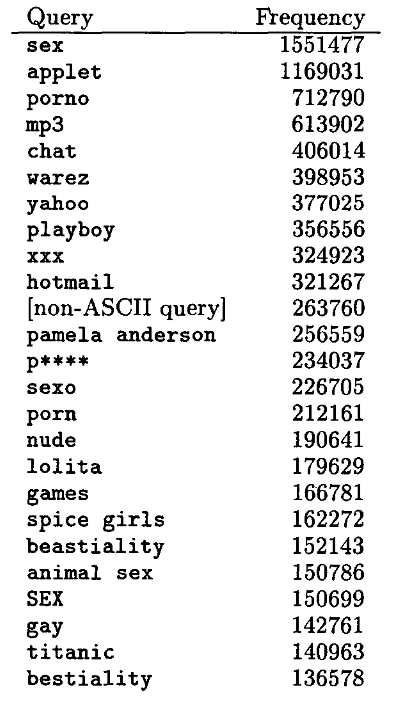
Both of these studies are focused on the top queries by rank and thus ignore the contribution of the long tail.
Conclusion
By 1987, the second generation of Community Memory had been used by some locations for three years. Posts reveal that the user community had developed a culture, with long-running debates and prominent personalities. User search patterns indicate that Community Memory was being used as a cross between a digital classified section and as a public forum. Similar to later social networking platforms, it was both a source of entertainment for readers, an outlet for writers, and a means of conducting commerce.
Appendix: OCR Prompt
We used this prompt with Google’s Gemini 3.7 LLM to perform the transcription:
Transcribe this document exactly as written.
Preserve the reading order, headings, paragraphs, tables, and line breaks as much
as practical. Do not summarize, translate, or add commentary. For tables, use
Markdown table syntax. Mark text that is genuinely illegible as [ILLEGIBLE].
Return only the transcription.
Appendix: Decision Model Call
We used this call to invoke Jev to perform the first draft classification of clusters into categories:
response = client.system_one(
    state={"document": " | ".join(all_terms)},
    questions={
        "craigslist": Choice(
            instructions="From this list of terms, what craigslist category is the best fit?",
            criteria={
                "community": "activities, events, local news and politics, volunteer opportunities",
                "services": "computer, creative, financial, household, legal, and similar services",
                "housing": "apartments, rooms for rent, housing rentals, real estate sales",
                "for sale": "antiques, appliances, computers, garage sales, furniture, tools, and other things for sale",
                "jobs": "jobs and employment opportunities that are medium to long term",
                "gigs": "jobs and employment opportunities that are short term",
                "individuals": "posts about specific people or usernames",
                "forum": "discussions about topics including philosophy, jokes, politics, and sports",
                "personals": "dating, meetups, and personal connections",
                "erotic": "sex, nudity, and other erotic content"
            }
        )
    }
)
References
(Farrington 1987) Farrington, Carl. 1987. Community Memory User Manual. The Community Memory Project. https://www.computerhistory.org/collections/catalog/102734471/.
(Jansen 1998) Jansen, Bernard J., Amanda Spink, Judy Bateman, and Tefko Saracevic. 1998. “Real Life Information Retrieval: A Study of User Queries on the Web.” ACM SIGIR Forum 32 (1): 5–17. https://doi.org/10.1145/281250.281253.
(Silverstein 1999) Silverstein, Craig, Hannes Marais, Monika Henzinger, and Michael Moricz. 1999. “Analysis of a Very Large Web Search Engine Query Log.” ACM SIGIR Forum 33 (1): 6–12. https://doi.org/10.1145/331403.331405.