Inventing ELIZA (Review)
This year is the 60th anniversary of Joseph Weizenbaum’s article “ELIZA—A Computer Program For the Study of Natural Language Communication Between Man and Machine”. ELIZA was a natural language “engine” for running scripts of various conversational personas. The DOCTOR script became the paradigmatic example of a chatbot and ELIZA was re-implemented many times. A team of eight multidisciplinary scholars (“Team ELIZA”) have written an expansive historical study of the creation of ELIZA, how it was designed and implemented, its impact, and latter development of chatbots to the present day.
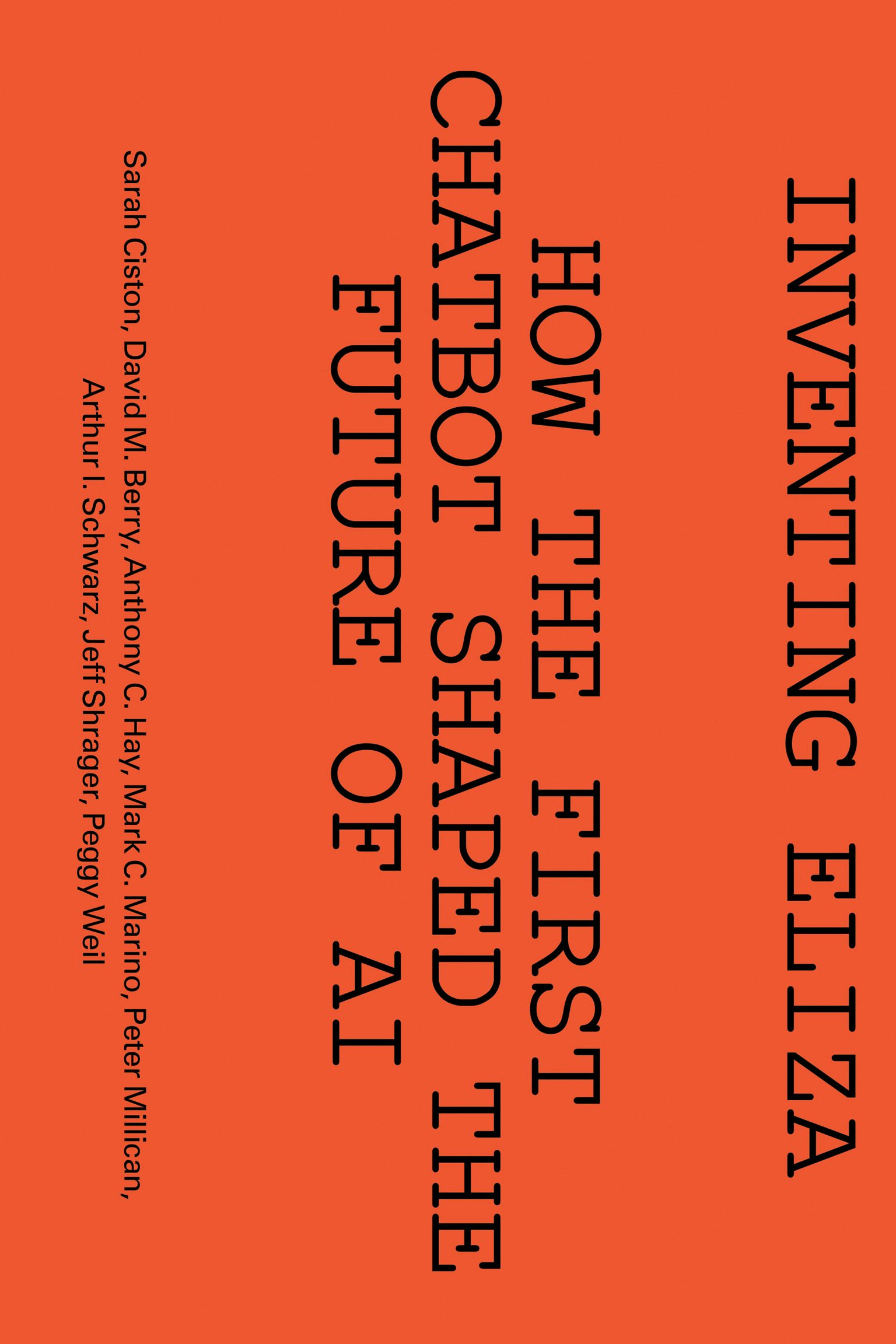
Inventing ELIZA: How The First Chatbot Shaped the Future of AI. 2026. By Sarah Ciston, David M. Berry, Anthony C. Hay, Mark C. Marino, Peter Millican, Jeff Shrager, Arthur I. Schwarz, and Peggy Weil. The MIT Press. Publisher Website
Inventing Eliza is broad in both its scope of historical analysis and in methodology. Content-wise, the book includes a biography of Joseph Weizenbaum, his family background and professional work that led to his time at MIT and later transition to a public intellectual. (The book only skims over Weizenbaum’s later years.) The book then includes a high-level description of ELIZA’s workings and a detailed look into the timeline of development of various personas and experiments. The team discovered a heretofore forgotten full copy of the ELIZA and DOCTOR script and provide a highly annotated copy of the MAD-SLIP implementation. The book covers later chatbot development, touches on philosophical lessons and implications of the “ELIZA Effect” and the role of deception in computer interfaces, and wraps up with a detailed comparison to modern LLM-based chatbots and conversational interfaces. Interspersed between the chapters are dialogues with various chatbots, with “ChatGPT as DOCTOR” being particularly humorous.
Positively, the book is expansive and thorough. The large team of authors bring a diversity of opinions, insights, and approaches. A reader will naturally find some arguments stronger and reject others, but because the book is a “big tent” they will find something appealing. I have to applaud the team for their appreciation of technical history. How ELIZA worked and the interplay between mechanisms such as memory and how scripts are designed is important for understanding how the combinations of simple mechanisms made conversations seem more “human” and engaging. The team explains the mechanisms both through a functional description in one chapter and a detailed, annotated copy of the source code distributed between two other chapters. Helpfully, they also include a short introduction to MAD-SLIP since its structure is unusual.
Negatively, the book is often repetitious, reminding the reader of Weizenbaum’s background and the distinction between ELIZA and DOCTOR. Wiezenbaum’s own writings and reflections on ELIZA are only lightly summarized. Methodologically, the study of an artifact and a phenomenon may or may not prioritize the creator, but when certain motivations are ascribed to the creator, and the creator passed away in 2008, his works should serve as a possible defense. For example, the books argues that Weizenbaum likely amplified the “ELIZA Effect” by curating transcripts (as demonstrated by multiple drafts of the same conversation) that demonstrate the effect and was predisposed to this deception by his early practical jokester personality.
I read the book in printed form. While the text and figures are crisp, I found many of the physical aspects of the production lacking. The paper is thin and the text bleeds through from the other side of the page. The outer page margins are quite short at only 1/5th of an inch. Meanwhile, the internal indentation (tabs) are overly generous at one inch (a page is only 6" x 9"). Left and right pages are formatted equally which creates uneven visual stretches of white space. Page 259 appears to be misprinted with a quote overlaid on a list of section contents. The back cover includes a free-floating “technology” text box. Since the book is available via Open Access in PDF and ebook formats, perhaps formatting for the printed page was an after-thought.
For the general practitioner, the book offers lessons on the design and effectiveness of conversational interfaces, with some specific insight into computer-aided instruction and psychotherapy use cases. Readers may gain an additional appreciation for the difficulty in ascertaining the “human”-ness or “AI”-ness of a given text. However, I would expect many practitioners will ignore the technical foundations of ELIZA, considering them obsolete with LLM technology. For historians, my recommendation is far stronger, as I find this book the best example of “critical code studies” methodology so far and a work that can engage future research into chatbot systems.